
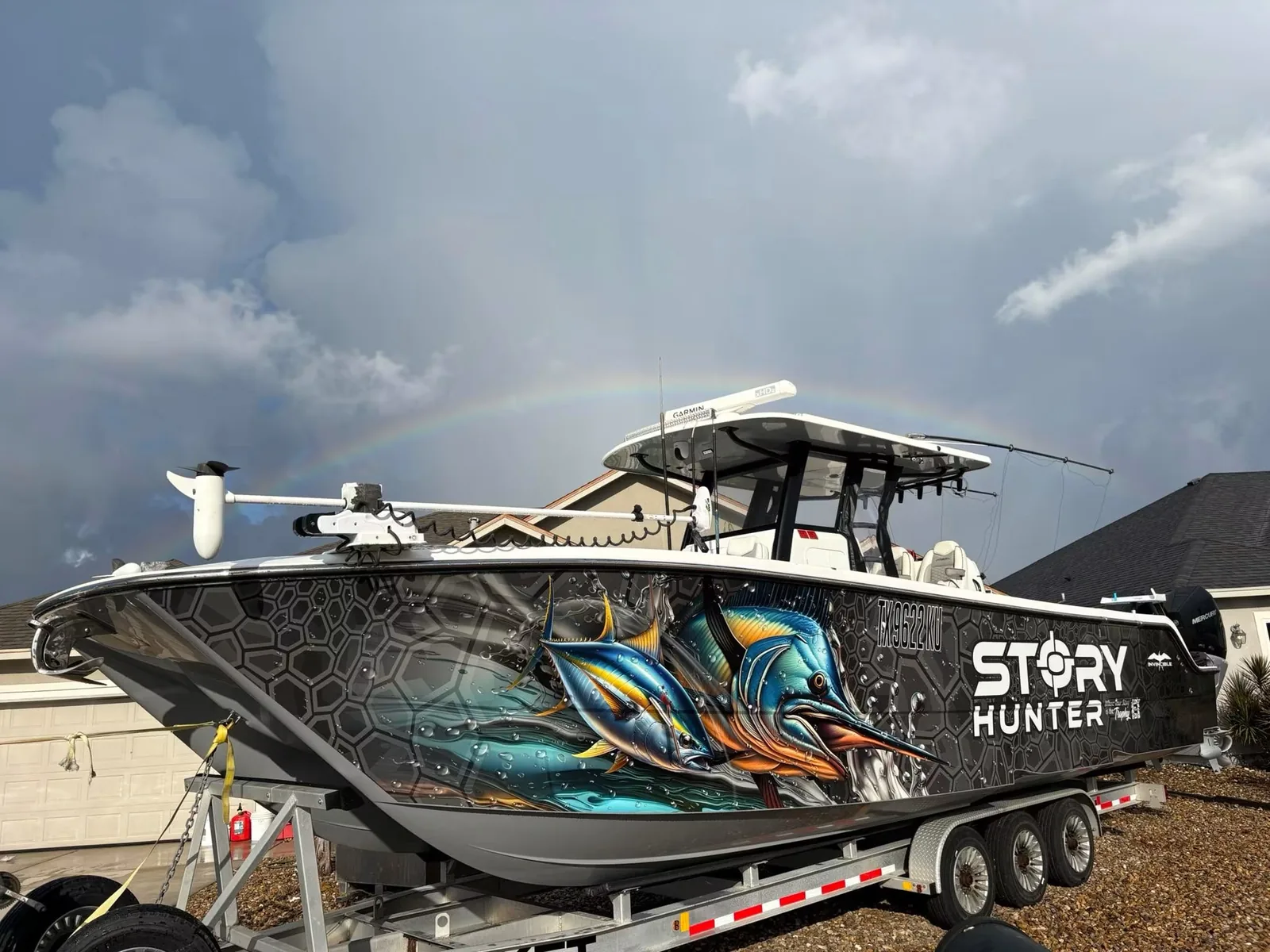
A boat on Matagorda Bay or San Antonio Bay works in sun, salt spray, and the hot glare off the water. That is a harder life for vinyl than a truck gets on US-59. Most boats we wrap come up from Port O’Connor, Port Lavaca, and the rest of the coast, so the build is planned around that from the first measurement.
This guide covers the choices boat owners and fishing guides ask us about most: how much of the hull to cover, how the wrap is built for salt water, what a guide boat should carry, and how to keep it looking right.
Full wrap, partial graphics, or names and numbers
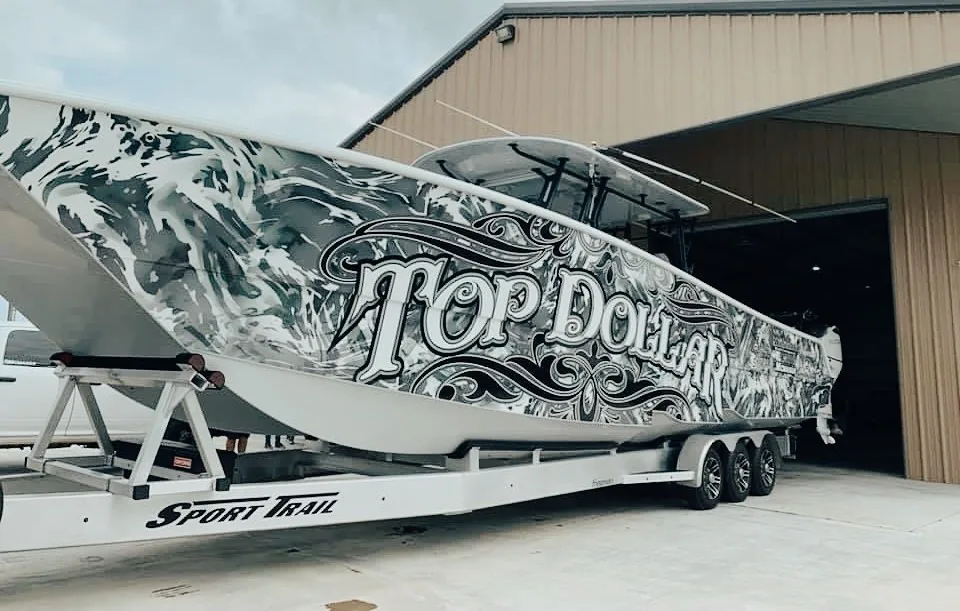
Full hull wrap
Printed vinyl covers the hull sides from the rub rail down toward the waterline, usually bow to transom on both sides. Full wraps are where camo patterns, fish artwork, and bold color changes live. A full wrap uses the most material and labor, so it costs the most.
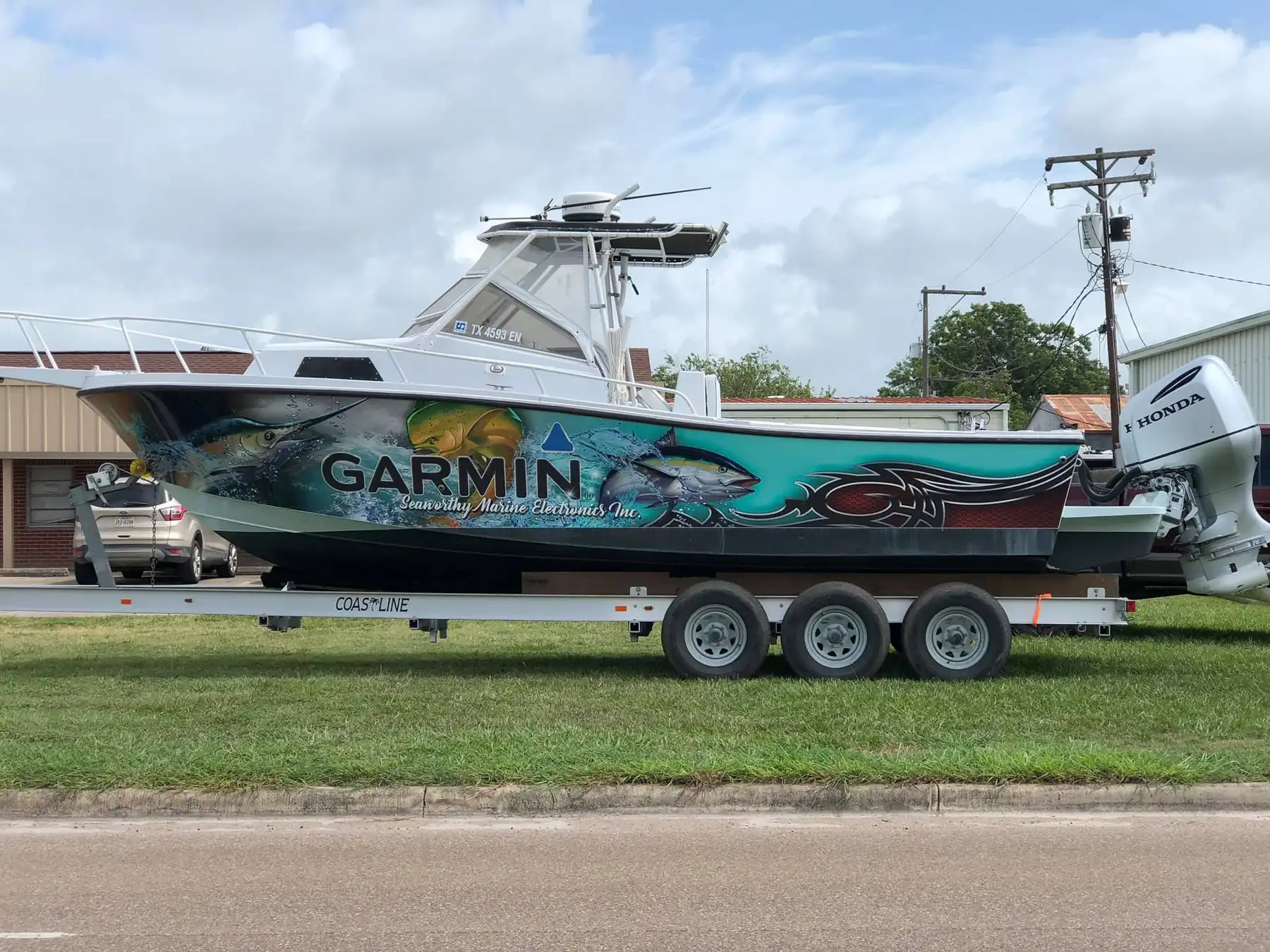
Partial graphics
Printed graphics cover part of the hull, often the forward half or a sweep from the bow back, and the gelcoat shows around them. On a white hull, this gives you a finished, branded look with a good deal less vinyl than a full wrap.
Names and registration numbers
Cut marine vinyl for the boat name, hailing port, and Texas registration numbers. No printed background. This is the least expensive option. It also gets added to most full and partial wraps, since the numbers have to be legible either way.
How a boat wrap is built for salt and sun
Salt, sun, and speed are hard on any wrap. Boats are the toughest job we take on, and that’s why a lot of shops won’t wrap them at all. Here’s how we build one to hold up:
- The vinyl. We print on Avery Dennison 1105, a cast vinyl made to stretch around compound curves and stay put. Cast film can only stretch about 10 to 15 percent before it wants to pull back. We stay inside that range and post-heat the deep curves to lock the film in place. Cheaper calendared vinyl shrinks back from curves and lifts at the edges.
- The laminate. A matching Avery Dennison UV overlaminate goes over the print. It keeps reds and blues from fading, and it takes the abuse instead of the ink. For boats we recommend a gloss finish. Matte and satin laminates are more porous, so salt and grime stain them more easily.
- The edges. Spray finds edges first, so every edge gets sealed. Sealing helps, but on a fast boat, speed and spray are still the main things that lift vinyl. That’s why care matters as much as the install.
The design matters too. Artwork gets mapped to the hull shape before printing, so a stripe or logo still runs straight after the vinyl stretches over the chine and around the bow. We also plan where the seams land. Panels get printed wider than needed and trimmed, so seams and overlaps sit in the hull lines instead of the middle of a flat panel. It takes more material and more time, but up close it looks like part of the boat.
What a guide or charter boat should carry
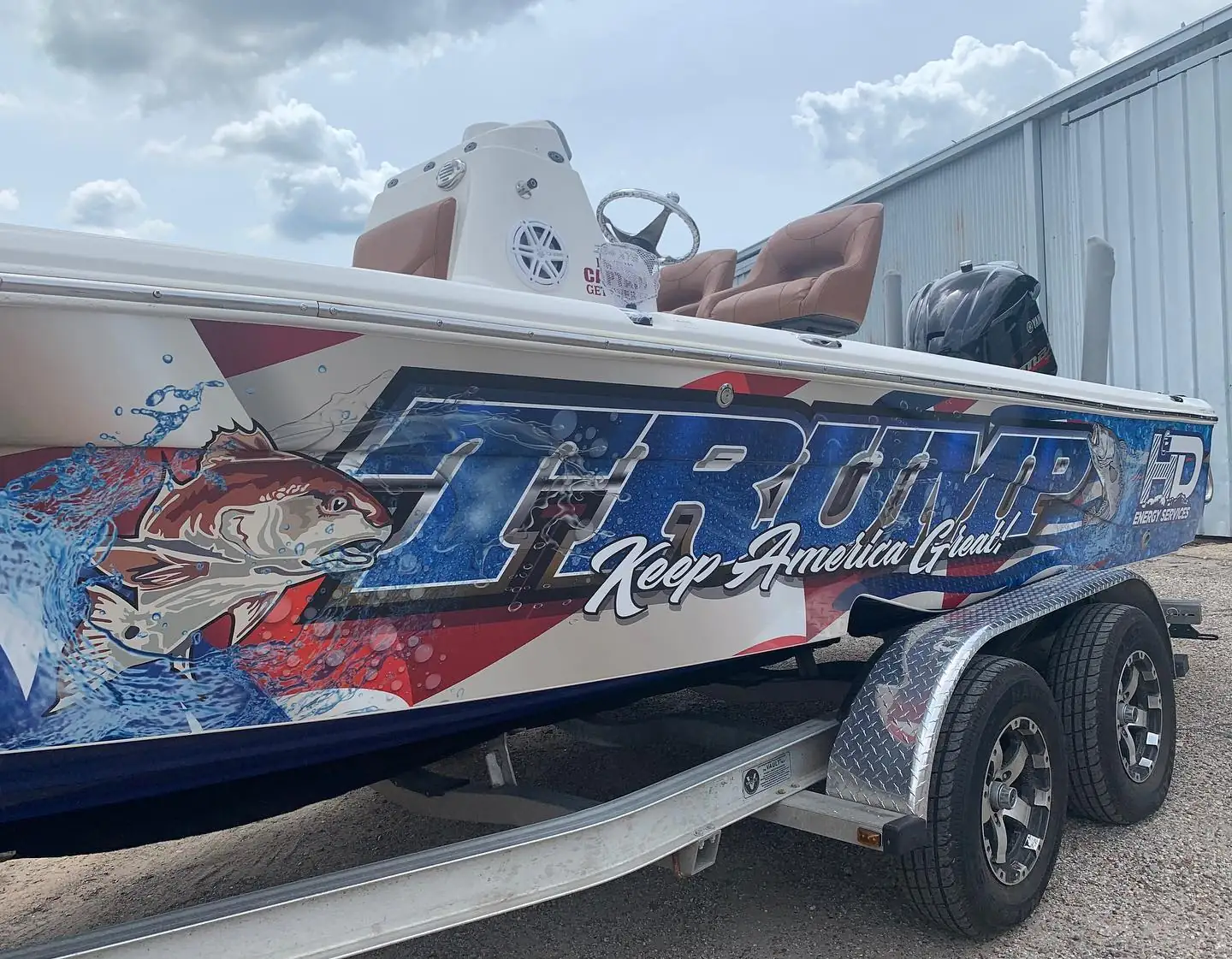
For a fishing guide, the boat is the business card. It sits at the ramp at Port O’Connor every morning and gets photographed with every good catch. These four things do the work:
- The guide service name, big enough to read from the ramp parking lot.
- A phone number, on both sides. A website or social handle can go under it, smaller.
- What you fish for or where, in a few words: “Bay fishing, Matagorda Island.”
- Registration numbers, laid out so they stay legible next to the artwork.
Many guides also letter the truck and the boat trailer to match. A matched rig reads as one business at the ramp and on the highway. See our trailer wraps and vehicle wraps pages for those.
Texas registration numbers
Numbers go on the forward half of both sides of the hull, in plain block letters at least 3 inches tall, in a color that contrasts with the hull. The validation decal goes close behind them. Texas Parks and Wildlife sets these rules, so check their current requirements before an inspection.
Fancy fonts and low-contrast colors are the usual problems. A gray number on a dark camo hull may look good in a mockup and fail at the ramp. We cut numbers that meet the rules and place them where the artwork leaves a clean background.
Getting the hull ready
Vinyl sticks best to smooth, glossy gelcoat and smooth aluminum. The glossier the surface, the stronger the bond. Vinyl doesn’t fix a bad surface, and it will show one. Before a wrap goes on:
- Ceramic coating and wax come off. Vinyl won’t bond to a hull that’s been ceramic coated or recently waxed. A detailer has to cut and buff the coating off first, so tell us about any coating up front.
- Oxidized gelcoat gets restored. If the gelcoat is chalky and leaves your hand white when you wipe it, vinyl won’t hold. We clean it, clay bar it, and bring the gloss back before wrapping. If the hull is too far gone, we’ll tell you before we start.
- Old graphics come off. Old decals, wraps, and the adhesive under them get removed. Removal is billed hourly, separate from the wrap, and older vinyl can pull gelcoat or paint with it.
- Damage gets repaired. Deep scratches, cracks, and gouges show through vinyl. Bondo and filler won’t hold vinyl either, so repaired areas need to be sanded, primed, and finished first. If your hull needs body work, we can point you to a shop we trust.
Send close-up photos of the hull with your quote request, and we’ll tell you what prep it needs. We still look at every boat in person before the install, because photos don’t show everything.
If the boat lives in a slip instead of on a trailer, tell us up front. It still has to be hauled out and brought to the shop for the install, and boats kept in the water are harder on vinyl. We’ll talk through what to expect before you book.
Caring for a wrapped boat
- Rinse with fresh water after every trip on salt water.
- Wash by hand with a soft brush or mitt and a low pH soap.
- Keep a pressure washer well back from the edges, or skip it. Close-range pressure washing lifts edges.
- Skip brush washes and drive-through washes.
- Cover it or park it in shade when you can.
- Ceramic coat the wrap. A coating makes the vinyl easier to clean and helps it shed salt and grime. On a wrap it’s simple: the vinyl gets wiped down with isopropyl alcohol and coated, with no paint correction needed. Ask us about it when you book.
A wrap changes the look of your hull and protects the gelcoat under it, but it behaves like paint. It can still chip and scratch, and it won’t stay perfect forever.
Every boat wrap we install is backed by The No-Peel Promise, one year of coverage on materials and installation. Lifting, bubbling, or peeling from our material or our work gets fixed. Damage from close-range pressure washing, brush washes, and impacts is not covered.
From the coast to the shop
Our Victoria shop is about 28 miles from Port Lavaca on US-87 and about 50 miles from Port O’Connor by way of SH-185. Owners trailer the boat up for the install. Most installs take 3 to 5 working days from print to finish.
To get a quote, send the boat’s make and length, photos of both sides and the transom, your registration number, and your logo if you have one. Use the contact form or call 361-730-1308. More finished boats are on our boat wraps page.